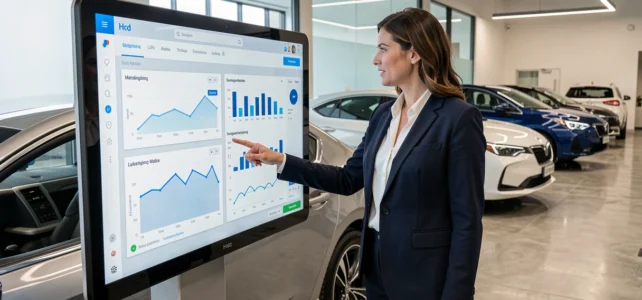
Automotive digital marketing is no longer just about a showcase website and a few posts on social media. Industry professionals, both dealerships and independent garages, are facing a rapid shift of advertising budgets towards formats linked to actual inventory, an increasing demand for measurable leads, and the emergence of artificial intelligence in the purchasing journey. Which levers truly drive results, and which ones are just noise?
VIN-based Campaigns and Google Vehicle Ads: The Lever Redefining Budget Allocation
The most structural change for dealerships concerns advertising campaigns based on the Vehicle Identification Number (VIN). Instead of promoting a model generically, these campaigns display in real-time the availability and exact price of a specific vehicle in Google and Meta ads.
The Google Vehicle Ads format, combined with dynamic inventory ads on Meta, allows sales teams to directly connect physical stock to advertising delivery. For dealerships specializing in used cars with smaller teams, this mechanism captures a dominant share of the digital advertising budget.
The benefits are twofold: the prospect sees a real vehicle with its price, reducing friction between online search and contact. For professionals looking to deepen these online automotive visibility strategies, it is possible to find more information on Opus Media regarding approaches tailored to the industry.

Lead-gen Sites vs. Showcase Sites: What Independent Garages Now Demand
Independent garages have long viewed their website as a digital brochure. This approach is no longer sufficient. An audit conducted by a specialized digital provider highlighted the priorities expressed by professionals: more requests for quotes and appointments, a site designed for lead generation, and measurable results.
Feedback shows that when a lead-gen oriented site is combined with targeted SEO, SEA, and an active presence on social media, requests and bookings increase rapidly after the redesign. The site becomes the central hub for customer acquisition, not just a simple catalog of services.
| Approach | Classic Showcase Site | Lead-gen Site Combined with SEO/SEA |
|---|---|---|
| Main Objective | Present the business | Generate requests for quotes/appointments |
| Role in the Customer Journey | Passive information point | Central acquisition hub |
| Performance Measurement | Number of visits | Qualified leads, conversion rate |
| Associated SEA Lever | Rare or absent | Targeted campaigns by service/area |
| Impact on Workshop Scheduling | Indirect | Direct online bookings |
This table summarizes the gap between two philosophies. The first relies on presence, the second on conversion. Digital providers that do not offer results-oriented reporting lose the trust of garages.
Google Business Profile and Local Automotive SEO: Geographic Anchoring as a Selection Filter
The majority of motorists search for a professional nearby. Google Business Profile remains the first point of contact between a potential customer and a garage or dealership. Analyzing the statistics of these profiles provides a direct indicator of local performance.
The factors that influence local ranking and the prospect’s decision include:
- The completeness of the profile (hours, services, recent photos of the workshop or showroom) affects positioning in geographic results
- The volume and freshness of Google reviews guide the prospect’s trust, especially for independent garages that do not have the notoriety of a brand network
- Systematic responses to reviews, both positive and negative, signal a commitment perceived as professional by algorithms and customers
Conversely, an incomplete profile or unanswered reviews create a negative signal that is difficult to compensate for with other levers. Local SEO is not just another channel for automotive: it is the foundation upon which other digital actions rest.

Generative Artificial Intelligence and Automotive SEO: A Paradigm Shift for Visibility
The emergence of response engines (Perplexity, ChatGPT, Gemini) is changing the way buyers search for information about a vehicle. We now speak of Generative Engine Optimization (GEO), a discipline that complements traditional SEO.
Future buyers ask complex and contextual questions to these tools. For a dealership or garage site to appear in the generated responses, the content must precisely address long, structured, and comparative queries. Summary product sheets or generic pages do not rank well in these new formats.
This shift has a direct consequence on content strategy: pages must provide factual and detailed answers, not just keywords. An article comparing two engine types with concrete data is more likely to be cited by a generative engine than a homepage optimized for a short query.
Automotive digital marketing is now structured around three measurable pillars: real-time inventory advertising, lead generation via conversion-focused sites, and SEO that integrates generative engines. Professionals who still treat their online presence as a secondary concern accumulate a delay that directly translates into their workshop scheduling and sales volume.