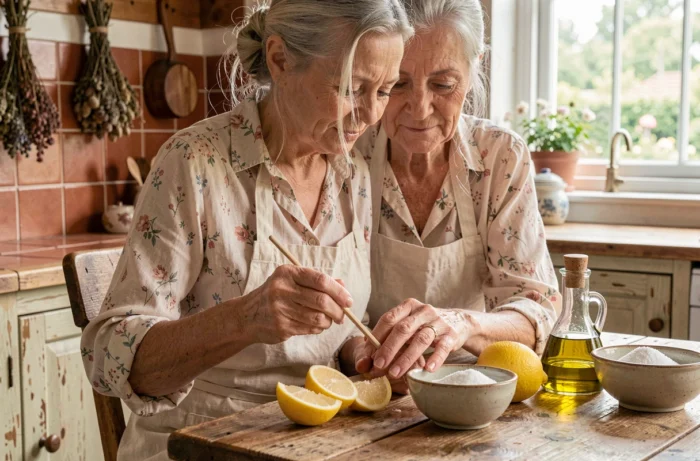
Between olive oil, lemon, baking soda, and honey, kitchen cabinets are full of ingredients commonly cited for strengthening or whitening nails. But do all these ingredients act in the same way, and especially on the same problem? Comparing their modes of action and their limitations allows for choosing an appropriate treatment rather than randomly mixing recipes.
Mode of action of natural ingredients on nails: comparative table
Each ingredient commonly used in home recipes targets a specific aspect of the nail. The table below summarizes their main function, mode of application, and the limitation to be aware of before using them.
| Ingredient | Main action | Common application | Limitation or precaution |
|---|---|---|---|
| Olive oil | Hydration of keratin and cuticles | Warm soak or direct massage | Does not affect the structural strength of the nail |
| Lemon | Whitening, mild antiseptic action | Soaking fingertips for a few minutes | Acidic: can dry out the nail with frequent use |
| Baking soda | Gentle exfoliation, cleaning nail polish residue | Paste mixed with water or oil | Abrasive: weakens the surface if used too often |
| Honey | Hydration, emollient effect on cuticles | Mask mixed with an egg yolk or oil | Limited effect on very brittle nails |
| Castor oil | Deep nutrition, softening | Brush application on the nail and surrounding area | Thick texture, requires a long application time |
What stands out: hydration and whitening are two distinct problems that call for different ingredients. Mixing lemon and olive oil in the same soak, as many recipes suggest, amounts to combining a drying agent and a moisturizing agent, which can limit the effectiveness of each.
To delve deeper into these ingredient combinations and find detailed protocols, home recipes on Kristal Beauté categorize each treatment by type of problem encountered.
Brittle nails and home recipes: what dermatology nuances
The majority of grandmother’s recipes for brittle nails rely on an external fatty application (olive oil, argan oil, shea butter). The idea is logical: dehydrated keratin becomes rigid and splits more easily. A warm oil soak temporarily softens the structure.
However, the American Academy of Dermatology points out a factor often underestimated: repeated cycles of wetting and drying further weaken nails than lack of hydration alone. Household chores, washing dishes without gloves, frequent hand washing create mechanical stress that even a weekly mask cannot compensate for.
In other words, wearing gloves during wet tasks likely has more impact on nail strength than an olive oil soak. The two do not exclude each other, but the order of priority matters.
The trap of homemade or commercial hardeners
Some recipes add crushed garlic or dried egg white to “harden” the nail. Hardeners sold in pharmacies sometimes contain formaldehyde, which can, with frequent use, make nails even more brittle and irritate the surrounding skin. The same principle applies to overly astringent homemade recipes: an artificially hardened nail loses flexibility and breaks under stress instead of bending.
- Prioritize hydration (oil, honey) rather than hardening for nails that split
- Limit exposure to water without gloves, the main cause of mechanical weakening
- Space out gel manicures, as their removal damages the superficial layer of the nail according to the recommendations of the American Academy of Dermatology
Yellowed nails: lemon, baking soda, and the limits of the cosmetic approach
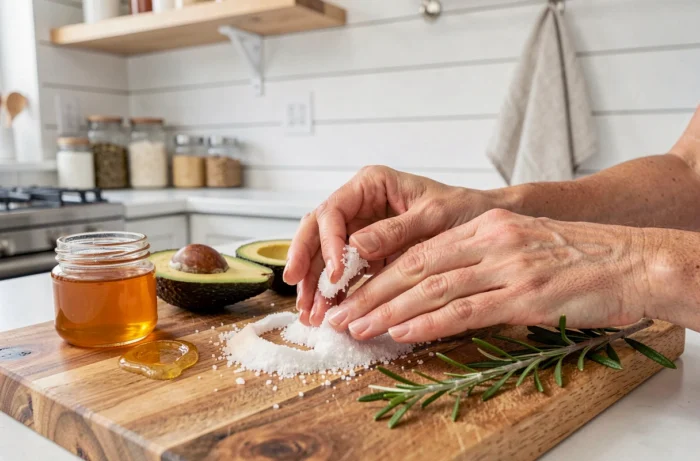
Yellowing of the nails is the second most common reason for searching for home recipes. Lemon juice and baking soda are consistently mentioned. Their mechanical and acidic action effectively removes superficial stains left by colored polishes or tobacco.
The problem arises when the yellowing is not superficial. A yellow, thickened, or brittle nail may signal a fungus or psoriasis, two conditions that do not respond to cosmetic treatment. Applying lemon to a nail infected by a fungus has no demonstrated antifungal effect and delays consultation.
Differentiating cosmetic stain and pathological sign
A simple criterion: if the yellowing affects only one nail, is accompanied by thickening or lifting of the nail bed, a medical opinion is necessary before any home recipe. If all nails show a slightly yellow tint after removing a dark polish, a lemon-baking soda soak for a few minutes remains a reasonable option.
- Uniform yellowing after polish: lemon soak or baking soda paste, once or twice a week maximum
- Localized yellowing with altered texture: priority dermatological consultation
- Prevention: apply a clear base before any colored polish to limit pigment migration
Cuticles and nail contour: the most underestimated care
Home recipes focus on the nail plate, but the condition of the cuticles directly affects healthy nail growth. Dry or torn cuticles expose the matrix to micro-infections that can deform the nail over several weeks.
Honey mixed with a teaspoon of olive oil, applied in a massage around the nail for a few minutes, softens the cuticles without being aggressive. Unlike the reflex action of cutting cuticles, this approach preserves their role as a protective barrier.
Mechanical removal of cuticles (metal cuticle pushers, cuticle nippers) is still not recommended for self-care. Gently pushing back after a warm soak is sufficient in most cases.
Home recipes for nails work best when they target a specific problem with an appropriate ingredient, rather than mixing everything in the same soak. Protection against water and household products remains the most effective gesture for maintaining strong nails daily, well before any mask or soak.