The fashion trends of 2026 are no longer just a list of pieces to buy each season. The French fashion market declined by 1.9% in value in the first quarter of 2026 compared to 2025, according to data from the French Institute of Fashion relayed by Shaare Agency. Online sales are increasing while physical retail is declining.
Second-hand represents about 40% of the French second-hand clothing market, with an annual growth rate close to 20%. These figures indicate a fundamental shift in how to build a coherent wardrobe over twelve months.
Fashion Market in France: What the 2026 Data Reveals About Shopping Habits
Competing articles list colors and silhouettes. They miss a structural shift that directly influences how to stay stylish throughout the year.
| Indicator | Trend 2026 | Impact on Style |
|---|---|---|
| New Market (Q1) | Decline of 1.9% in value, March at -3.7% | Fewer impulse purchases, a shift towards durable pieces |
| Online Sales | Continuous growth against physical retail | Improved access to second-hand pieces and niche brands |
| Second-Hand (Fashion Share) | About 40% of the second-hand market, annual growth close to 20% | Mixed new/second-hand wardrobe, resale value as a purchase criterion |
| Growth of New Clothing Online | 5 to 7% per year | Significantly lower rate than second-hand |
This data changes the very logic of the wardrobe. Buying less, choosing better, reselling: this sequence replaces the seasonal reflex of accumulation. A stylish piece in 2026 is also a piece that retains its resale value and stylistic longevity.
To follow these changes over the months, fashion information on Actualité Premium allows for cross-referencing market data and seasonal insights.
Trending Colors and Materials: Choices That Span the Seasons
The 2026 palettes move away from the minimalism of neutral tones that have been prevalent in recent years. Lavender, glacier blue, burgundy, and chocolate are establishing themselves as foundational colors, not just fleeting flashes. In contrast, bright yellow and saturated purple remain riskier over time: their massive adoption in spring does not guarantee their relevance in autumn.
The advantage of a wardrobe designed for the year is to distinguish foundational colors from accent colors. Burgundy works from autumn blazers to light spring trousers. Lavender transitions from a summer dress to a winter knit sweater.
Materials to Favor for a Cohesive Look All Year Round
- Ribbed knit, dense enough for winter, worn in a fine version in spring: a basic that spans the seasons without looking out of place
- Mixed linen (linen-cotton or linen-viscose), which has more structure than pure linen and can be worn from early spring to late autumn depending on thickness
- Soft leather or quality faux leather, present on both mid-season jackets and accessories (bags, belts), and retains its value well for resale
- Cotton poplin, the basis for shirts and blouses: a fabric that transitions smoothly from chic workwear to a more casual weekend style
The choice of materials matters more than the choice of cuts to ensure versatility. A piece made from noble material resells better and ages better than a trendy synthetic garment.
Fashion Pieces to Adopt for a Cross-Seasonal Spring-Autumn-Winter Style
Competitors detail blazers, midi dresses, and straight jeans at length. These pieces remain relevant, but the angle that is often missing is the combination between them, season after season.
The Structured Blazer as the Wardrobe Pivot
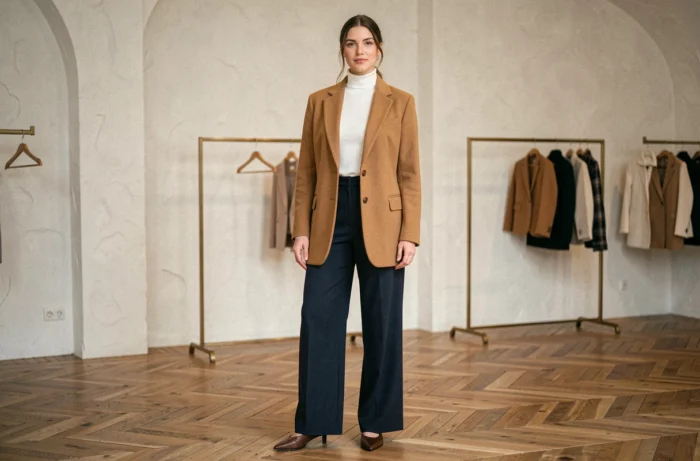
The blazer is not a trend for 2026; it is a tool. Worn over a cotton t-shirt in spring, over a turtleneck in winter, over a flowy dress in summer: it structures the silhouette regardless of the context. In burgundy or chocolate, it captures the two key colors of the season without becoming outdated in six months.
Straight Jeans and Fluid Trousers: Two Cuts Are Enough
Straight jeans remain the most versatile trousers in the 2026 wardrobe. Its cut works with sneakers, loafers, or ankle boots. Conversely, high-waisted fluid trousers provide a more dressed-up alternative for the same scenarios. There is no need to multiply cuts: two well-chosen bottoms cover most situations.
The Dress as a Cross-Seasonal Piece
The midi dress in knit or poplin spans the seasons with a simple layering game. Alone in summer, under a trench in spring, with opaque tights and a leather jacket in autumn. Layering transforms the same piece into three distinct looks.
Anti-Greenwashing Directive and Sustainable Fashion: A Regulatory Framework That Changes the Game
The European directive known as Empowering Consumers (sometimes referred to as the anti-greenwashing directive) imposes restrictions on environmental claims starting September 27, 2026. The terms “eco-friendly,” “sustainable,” or “green” can no longer be used without verifiable proof.
This regulatory framework has a concrete effect on fashion purchases. Brands that communicated about sustainability without solid data will either have to prove their claims or remove these mentions. For consumers, this means that verifiable labels and certifications (certified material, documented traceability) become the only reliable benchmarks.
Buying “sustainable” in 2026 requires checking evidence, not slogans. This requirement aligns with the resale logic: a garment whose composition and origin are traceable resells better on second-hand platforms.
The French fashion market is undergoing a transformation where style and the economic value of a garment converge. The pieces that span the seasons (structured blazer, straight jeans, midi dress in noble material) are also those that retain their appeal in the second-hand market. March 2026, with its 3.7% decline in the new market, confirms that seasonal accumulation is losing ground to a streamlined wardrobe designed to last.