
The proliferation of platforms, professional portals, and veterinary mobile applications has fragmented access to online resources. Between databases of medications, pharmacovigilance sheets, patient record management tools, and regulatory news feeds, finding the right information at the right time often feels like an obstacle course. Here, we discuss the technical points that condition smooth access to these resources.
Interoperability of Veterinary Portals: The Technical Lock
Most practitioners juggle between three to five distinct interfaces daily: clinic management software, veterinary medication databases, the Order portal, continuing education platforms, and possibly a client follow-up application. The central problem is not the number of tools; it is the lack of a data exchange standard between these platforms.
Unlike the human health sector, where standards like HL7 or FHIR structure exchanges, the French veterinary world lacks an imposed interoperability framework. Each software publisher uses its own data format for patient records, prescriptions, and care histories.
The direct consequence: frequent manual re-entry, risks of errors in dosages, and significant time loss. We recommend systematically checking if your management software offers API connectors to the databases you consult most. Some publishers have begun integrating gateways to veterinary product catalogs and pharmacovigilance databases, but these features often remain optional and charged extra.
To centralize your document monitoring and consultation tools, veterinary resources on Espace Animaux gather several useful entry points, particularly regarding access to GMVet services.

Regulatory Framework for Online Veterinary Communication since July 2026
The decree n° 2026-672 of July 27, 2026 has profoundly modified article R.242-35 of the Rural Code. The communication of veterinarians is now free, regardless of the medium and modalities, including on social networks, websites, and applications.
This freedom comes with specific constraints that every practitioner publishing online content must master:
- Content must be fair, honest, and scientifically supported. A clinical blog post mentioning a protocol must rely on verifiable data.
- Any comparison with colleagues is prohibited. This includes implicit formulations like “unlike usual practices.”
- The regulation of client testimonials is strict: their publication is possible but regulated, and links to commercial brands must be transparent.
- Pricing information can be communicated, but within a framework that excludes any form of comparative advertising.
This decree changes the game for clinics that provide online resources (advice sheets, prevention videos, animal health guides). Publishing content is no longer a gray area of ethics, but the editorial responsibility of the practitioner is engaged with each publication.
Veterinary Telemedicine in France: Real Legal Limits
Several platforms offer online veterinary consultations with promises of diagnosis and prescription. The legal reality in France is quite different. The decree of May 5, 2020, which opened an experiment in veterinary telemedicine, ended in November 2021 without being replaced by a sustainable framework.
In practice, remote veterinary acts remain limited to advice without diagnosis or prescription. Any platform that promises an online diagnosis operates in a legal gray area that the practitioner must evaluate before attaching their practice to it or directing their clients there.
This situation creates a concrete gap between what pet owners find online and what is legally achievable. For a veterinarian, directing a client to a reliable digital resource (health sheet, first aid protocol, vaccination reminder) remains legally safer than validating the use of an unregulated teleconsultation app.
Structuring Access to Animal Health Data Daily
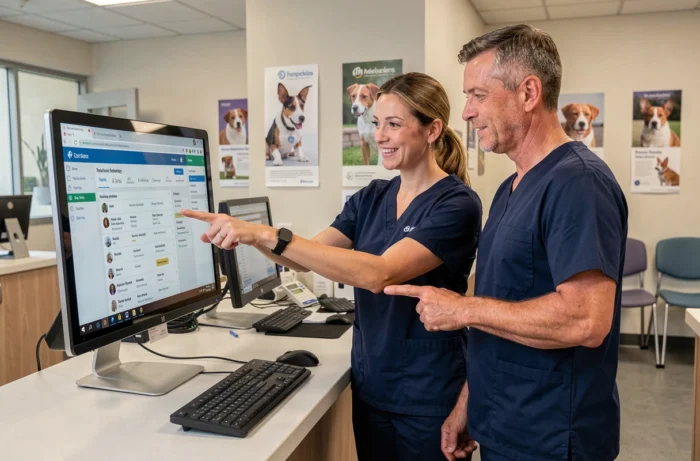
Rather than multiplying favorites in a browser, we recommend a feed-based approach. Tools like RSS aggregators or personalized dashboards allow you to centralize updates from the sources you regularly consult: pharmacovigilance alerts, new marketing authorizations, news from the Order, or publications from competent health agencies.
The choice of consultation format also matters. Veterinary medication databases often offer several access formats: web interface, PDF export, and sometimes direct integration into management software. Prioritizing native integration into clinic software reduces transcription errors and speeds up prescription writing.
Managing Access and Multiple Identifiers
A often-overlooked point: managing identifiers. Between the Order account, access to training platforms, supplier portals, and specialized databases, a practitioner easily manages a dozen username/password pairs. A dedicated password manager (not the browser) with two-factor authentication is a minimum security measure, especially when these accounts provide access to sensitive animal health data.
Mobile Clinic Applications: What They Really Change
Mobile veterinary clinic applications (digital health records, vaccination reminders, appointment scheduling) have multiplied. Their main interest is not the client-side gadget, but the automatic synchronization with the practitioner’s patient record. A vaccination reminder accepted by the owner through the app directly generates an entry in the schedule, without human intervention.
The determining selection criterion remains compatibility with your existing management software. An application disconnected from your information system creates more work than it eliminates.
Accessing online veterinary resources is not just about finding the right link. It is a matter of technical architecture, regulatory compliance, and choosing compatible tools. The July 2026 decree clarifies what practitioners can publish, but the lack of a framework for telemedicine maintains an area of uncertainty that each clinic must manage carefully.