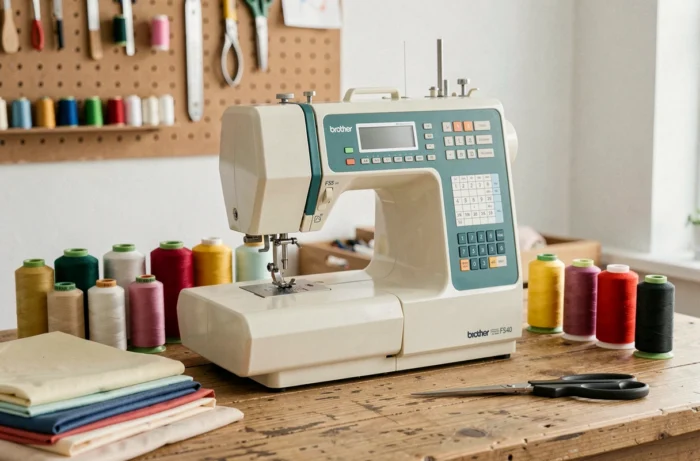
You just bought your first fabric coupon, you have a project idea in mind, but you’re missing the machine. The Brother FS40 consistently comes up in recommendations from beginner seamstresses, and it’s no coincidence. This electronic sewing machine combines an affordable price, quick handling, and versatility that allows you to progress without changing equipment after six months.
Threading and bobbin: two steps that make all the difference in everyday use
Before discussing stitch types or motor power, let’s address the question that really matters when you’re starting out. Why do so many machines end up in a closet after three uses? Often because threading the upper thread and setting up the bobbin can be discouraging.
The Brother FS40 solves this problem with an assisted threading system that guides the thread from the spool to the needle’s eye following a path directly printed on the machine. You just have to follow the numbered markers. The bobbin, on the other hand, is placed flat under a transparent cover: you can constantly see the amount of thread remaining, which prevents unpleasant surprises in the middle of sewing.
This transparent cover may seem trivial, but it saves a considerable amount of time. On a traditional machine, you have to remove the bobbin, estimate the remaining thread, and then put it back in place. Here, a simple glance is enough. For those who want to discover the Brother FS40 sewing machine in detail, these two points are often the first mentioned in user feedback.

Sewing stitches of the Brother FS40: which ones are really useful
The machine offers forty sewing stitches. This number is impressive, but let’s be honest: on a daily basis, you’ll use just a handful. The straight stitch and zigzag stitch cover the majority of common projects (hems, assemblies, edge finishes).
What makes this selection relevant is the presence of stretch stitches suitable for stretch fabrics. If you’re sewing jersey for a t-shirt or leggings, these stitches accommodate the fabric’s elasticity without breaking the thread. On a low-end machine lacking these stitches, the thread breaks at the first tension.
The one-step automatic buttonhole
Making a neat buttonhole by hand requires experience. The FS40 features a one-step automatic buttonhole: you place the button in the dedicated presser foot, and the machine adjusts the buttonhole length. The result is consistent even the first time.
Decorative stitches, on the other hand, remain a pleasant bonus for personalizing a project, but they are not the main purchase criterion. Focus instead on the quality of utility and stretch stitches, which determine the machine’s real capabilities.
Speed control and LCD screen: sew without stress
Have you ever tried driving a car that only has two modes, stop and full speed? That’s exactly how beginners feel on a machine without speed control. The Brother FS40 features a progressive speed slider that allows you to significantly slow down the sewing speed in delicate passages (curves, angles, multiple thicknesses).
This slider is combined with a small LCD screen that displays the selected stitch, the recommended width, and stitch length. You don’t need to consult the manual with every change: the screen guides you directly.
Presser foot and pressure on the fabric
The machine comes with several interchangeable presser feet (zipper, buttonhole, topstitching). Changing the foot takes just a few seconds thanks to the quick snap-on system.
One point that online tests rarely mention: the presser foot pressure is not adjustable on the FS40. In practical terms, this means that very thick fabrics (multi-layer denim, thick leather) can pose feeding difficulties. For common thicknesses (cotton, linen, poplin, jersey), the default pressure works perfectly.

Brother FS40 and durability: a criterion that has become regulatory
Buying a sewing machine is an investment for several years. The question of longevity now goes beyond mere personal opinion from users.
Since July 2024, the European regulation ESPR (Ecodesign for Sustainable Products Regulation, EU 2024/1781) extends ecodesign requirements to almost all physical products sold in the European Union, including electronics and household appliances. The objective is clear: sustainability, reparability, and availability of spare parts become mandatory design criteria, not just marketing arguments.
For a machine like the FS40, this means that manufacturers will gradually have to provide more information on reparability and product end-of-life. Brother, as a brand widely distributed in Europe, will need to adapt its entry-level ranges to these requirements to continue marketing them.
In practice, choosing an established brand with a dense European distribution network (authorized dealers, referenced spare parts) serves as a form of guarantee. Bobbins, needles, and presser feet compatible with the FS40 are easily found, which reduces the risk of obsolescence.
The limits to know before buying the Brother FS40
No machine in this price range does it all. Here are the points to keep in mind:
- The presser foot pressure is not adjustable, which limits work on very thick or very thin fabrics (organza, chiffon)
- The lighting in the sewing area remains basic; an additional LED lamp significantly improves visual comfort
- The operating noise, although moderate, can be surprising at high speed in a small space
- The machine does not have a knee lifter to raise the presser foot, which requires using the manual lever for each repositioning of the fabric
These limitations do not prevent you from completing the vast majority of sewing projects for a beginner or intermediate seamstress. They only become bothersome for specialized uses (leather goods, technical fabrics, intensive daily sewing).
The Brother FS40 remains an electronic sewing machine that does well what it was designed for: supporting progress in sewing without imposing frustrating compromises. The day its limitations become yours, you’ll know exactly what you’re looking for in a higher-end machine, and that’s precisely the sign that it has fulfilled its role.