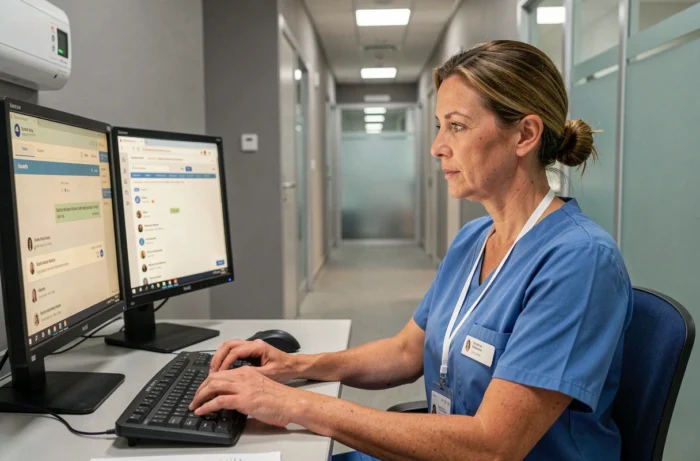
Sending a report to the wrong recipient, wasting time on a login screen between appointments, or sharing a patient document through an unsecured channel: these situations occur regularly in Paris hospitals.
AP-HP email, reserved for staff of the Assistance Publique – Hôpitaux de Paris, centralizes professional communications in a protected environment. This guide compares the different access methods, identifies the most common pain points, and explains the security practices that genuinely protect health data.
AP-HP email login methods: comparing access options
There are three ways to access your AP-HP work email. Their technical features differ in ways that matter in day-to-day use.
| Criterion | Web access (browser) | Desktop client (Outlook) | Mobile app |
|---|---|---|---|
| Available outside the AP-HP network | Yes, with strong authentication | Yes, with local synchronization | Yes, with MFA |
| Shared calendar access | Yes | Yes, integrated | Partial, depending on the device |
| Large attachments | Limited by the browser | Native support | Downloads can sometimes be slow |
| Strong authentication (MFA) | Required | Required | Required |
| Access to the AP-HP directory | Yes | Yes | Yes |
Strong authentication (MFA) is the common denominator. Regardless of the method you choose, two-step identity verification is required to access the email system.
The desktop client is best suited to fixed workstations in hospital departments, particularly for handling large attachments (medical imaging, reports). Web access is convenient for occasional use from a shared workstation. The mobile app is mainly for quick checks between shifts.
For more information on the initial login steps and password recovery procedures, AP-HP email for healthcare professionals explains each stage of the authentication process.
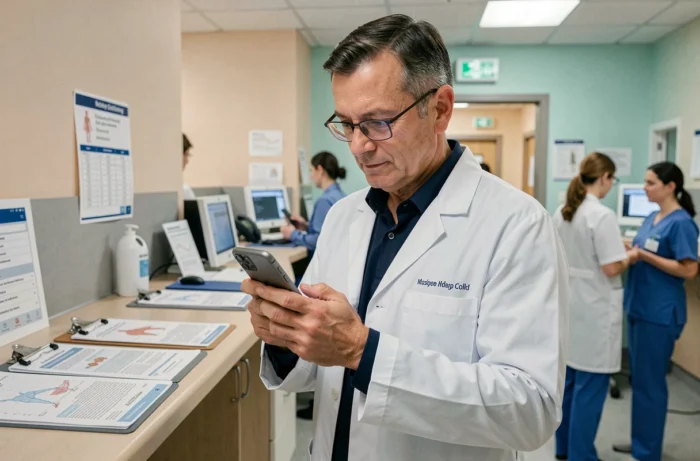
Health data security: AP-HP email requirements
AP-HP email is more than a standard webmail service. It operates in a context where every message may contain identifiable medical data. The CNIL notes that ordinary email is not, by default, a secure way to transmit this type of information and recommends encrypting it systematically.
The AP-HP environment includes encryption as a standard feature. Messages travel over infrastructure hosted in accordance with the requirements applicable to health data. Although the use of MSSanté is not mandatory in itself, professionals must still secure their communications and comply with health data hosting rules, as specified by the Agence du numérique en santé.
The main risk is not encryption
Sending a message to the wrong recipient remains the leading cause of data breaches, even in an encrypted system. The CNIL points out that a mistyped address can disclose medical information to an unauthorized person.
Autocompletion in the AP-HP directory increases this risk. Two similar names in the directory are all it takes to send a surgical report to the wrong department. Checking the recipient and attachments before every send should be treated as a clinical habit, just like verifying a patient’s identity.
- Check the recipient’s full name and department as displayed by autocompletion, not just the first few letters
- Check each attachment individually before sending, especially when several patient records are open at the same time
- Never forward an internal AP-HP message to a personal address (Gmail, Yahoo) to read it at home
- Report any misdirected message immediately to the department’s IT contact to limit data exposure
AP-HP email and consumer messaging apps: key differences
Using WhatsApp or a personal messaging app to coordinate a care team remains common in hospitals. However, there are significant differences between these tools and institutional email in three key areas.
Communication traceability
AP-HP email keeps a timestamped record of every message in an auditable environment. A WhatsApp exchange between two healthcare professionals about a patient provides no usable audit trail in the event of a dispute or quality audit. This difference matters greatly when tracking clinical decisions.
Compliant data hosting
Consumer messaging servers do not meet health data hosting requirements. AP-HP messages are stored on compliant infrastructure that meets applicable standards, protecting both the institution and the professional in the event of an inspection.
Integrated directory and shared calendar
The AP-HP directory lets you contact any colleague across Paris hospitals. The shared calendar makes it easier to schedule department meetings, clinical case conferences, and multidisciplinary coordination. No consumer app offers this kind of direct integration with the hospital organization chart.

Troubleshooting AP-HP email: common access issues
Access problems tend to follow recurring patterns. Identifying them can help before you contact IT support.
- Expired password: security policy requires passwords to be changed periodically. An expired password can block access without displaying a clear error message in some clients
- MFA not configured on a new device: changing phones without transferring the authentication app cuts off mobile access
- Unsupported browser: some older browser versions do not support the web interface and display a blank page
- Full mailbox: large attachments (medical imaging, large PDFs) quickly use up the quota and prevent new messages from being received
Password resets and MFA setup account for most IT support requests. Taking care of these two issues in advance prevents most access interruptions.
AP-HP email is a clinical tool in its own right, not a standard email service. Checking recipients and choosing the right communication channel helps protect patients and the professionals who care for them.